
If you have been told a tooth needs a crown when you were expecting a filling, the natural question is whether the larger option is really necessary. It is a fair question, and there is a reasonably objective answer.
The decision is not about the size of the hole. It is about how much sound tooth structure remains and whether that structure can survive being loaded thousands of times a day.
What each option actually does
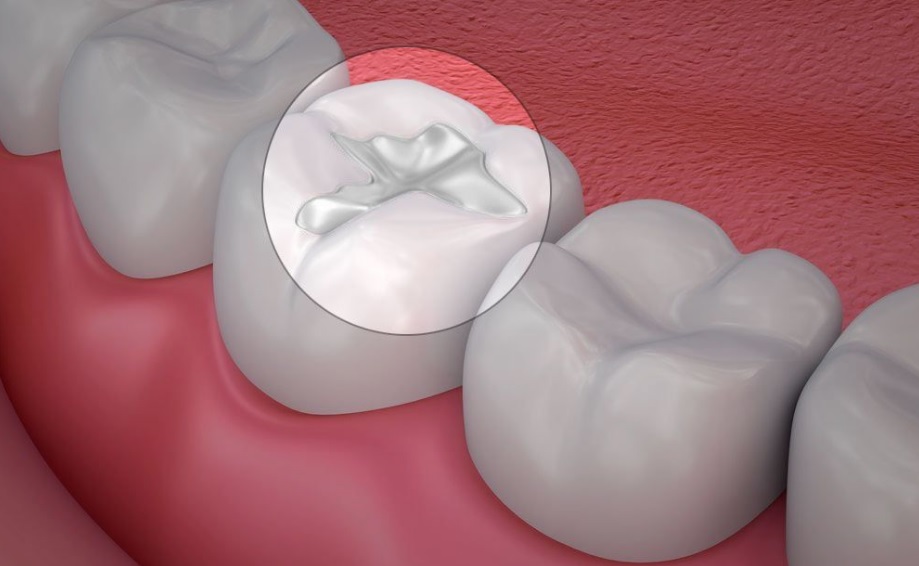
A filling replaces missing tooth structure from the inside. Composite resin is bonded into the cavity and supported by the walls of the tooth around it. The remaining tooth holds the filling.
A crown does the opposite. It covers the tooth and wraps the remaining structure, so the crown holds the tooth together rather than the other way around. That difference in mechanics is the whole basis of the decision.
The factors that decide it
How much tooth is left
The usual guide is the walls, or cusps. A back tooth with all its cusps intact and a cavity in the middle is a filling. Once one or more cusps are undermined, they are liable to split off under biting load, and covering them becomes the safer option. A rough working rule is that when more than about half the biting surface is gone, a filling is being asked to do a job it is not built for.
Whether the tooth has cracks
Cracks travel. A tooth with a crack line running across the biting surface, particularly one that produces pain on release of biting pressure, is at risk of splitting. A crown holds the segments together. A filling placed inside a cracked tooth can act as a wedge.
Whether the tooth has had root canal treatment
Root treated back teeth are more brittle, largely because so much structure has been removed to access the canals. Crowning them substantially reduces the risk of a later fracture that would cost the tooth entirely. Root treated front teeth with most of their structure intact can sometimes be restored with a filling alone.
Where the tooth sits in the mouth
Molars take the heaviest load. The same amount of damage on a molar and on a front tooth will not lead to the same recommendation.
How you use your teeth
A patient who grinds heavily puts every restoration under more stress, which shifts the threshold toward full coverage. It also means the grinding itself needs addressing, or the new crown will face the same forces that broke the tooth.
The options in between
It is not a binary choice. An onlay, sometimes called a partial crown, covers the weakened cusps while leaving sound tooth structure untouched. Where only one or two cusps are compromised, an onlay is often the more conservative and appropriate answer. Ask about it if your tooth sits in the grey zone.
The case for not waiting
The uncomfortable arithmetic is that a tooth which needs a crown and receives a filling instead often ends up needing more, not less, treatment. If the tooth splits below the gum line, it may no longer be restorable at all, and the conversation moves to extraction and replacing the tooth, which is a considerably larger undertaking.
That said, a second opinion is entirely reasonable for any recommendation of this size, and any dentist should be comfortable showing you the x-ray and the intraoral photograph the recommendation is based on. Ask to see them.
How the appointments differ
A filling is a single visit. A conventional crown traditionally takes two, with a temporary crown in between while the laboratory makes the final one. Our practice also offers CEREC same-day crowns, where the tooth is scanned, the crown milled on site and fitted in one appointment. We describe that process in what happens in a CEREC appointment.
What each costs
Tooth-coloured fillings at Civic Gentle Dental Care range from $209 to $450, depending on the severity of the decay and the number of surfaces being restored. Porcelain crowns start from $1,800, varying with the condition of the tooth, the amount of enamel wear and the extent of decay present. Where root canal treatment is needed first, that ranges from $1,200 to $2,000 depending on the tooth, and excludes the final restoration.
You will receive an itemised plan before treatment begins. Current fees are set out on our price list, and there is more detail on dental crowns and on fillings and restorations.
Common questions
Can I have a filling now and a crown later?
Sometimes, as a deliberate interim measure. It is a reasonable plan when the tooth is stable and the aim is to stage treatment. It is not a good plan when the tooth is already cracked, because the risk being managed is a sudden split.
How long does a crown last?
Well-maintained crowns commonly last many years, but the lifespan depends on gum health, grinding, decay at the margin and how the bite loads the tooth. Longevity is affected by maintenance rather than fixed by the material.
Will the crown match my other teeth?
Porcelain crowns are shade matched to the neighbouring teeth. If you are also considering whitening, do it before the crown is made, because a crown will not change colour afterwards. We explain why in why whitening does not change crowns and veneers.
Does having a crown mean I will need root canal treatment?
No. Many crowns are placed on teeth with a healthy pulp. Root canal treatment is needed only when the nerve is irreversibly inflamed or infected.
Booking an appointment in Canberra City
Civic Gentle Dental Care is at Suite 8, Level 3/161 London Circuit, Canberra City, a short walk from the Canberra Centre. To arrange an appointment, call (02) 6247 0224 or send us a message through our contact page.
This article is general information only and is not a substitute for individual dental advice. Whether a treatment is suitable for you, and what it will involve, can only be determined after an examination by a dentist. Any prices mentioned are estimates drawn from our current price guide and are not a quote.