
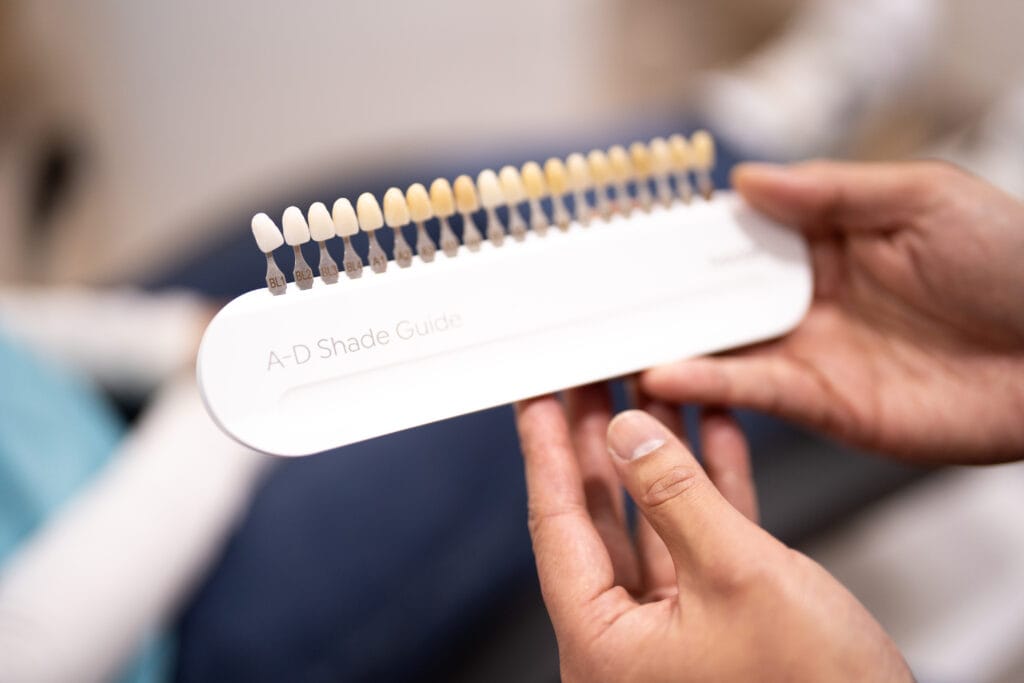
It catches people out regularly. A whitening treatment lightens the natural teeth beautifully and leaves the crown on the front tooth exactly the shade it always was, now conspicuously darker than everything around it.
This is not a fault in the treatment. It is how the chemistry works, and it is entirely predictable, which means it is entirely plannable.
How whitening works
Whitening gels contain hydrogen peroxide or carbamide peroxide. The peroxide penetrates the enamel and reaches the dentine underneath, where it breaks down the larger pigment molecules that have accumulated over years of coffee, tea, red wine, tobacco and simple ageing. Smaller molecules reflect light differently, and the tooth appears lighter.
The key point is that the process depends on a porous, mineralised natural tooth structure to penetrate.
Why restorations do not respond
Porcelain, ceramic and composite resin contain no such structure. Their colour is fixed at manufacture, whether that is a shade chosen by a ceramist or a composite shade selected by the dentist. Peroxide has nothing to act on. A glazed porcelain crown is non-porous, so the gel does not penetrate at all.
This applies to everything artificial in your mouth: porcelain and composite veneers, crowns, bridges, implant crowns, tooth-coloured fillings and denture teeth. None of them will lighten, at any concentration, with any system, in-chair or take-home.
The sequence that avoids the problem
- Whiten first. Complete whitening on the natural teeth before any new restoration is made.
- Wait two weeks. The shade rebounds slightly after treatment as the teeth rehydrate, and bonding is compromised immediately after whitening. Two weeks allows the shade to stabilise and the bond strength to return to normal.
- Then match the restoration to the settled, lightened shade.
Doing it the other way round leaves you choosing between a mismatch and remaking work you have just paid for.
If you already have restorations
You still have options, though they involve more than a gel.
- Whiten anyway and replace the visible restorations afterwards. The usual approach where a front crown or veneer is involved. Budget for the replacement as part of the plan rather than as an unwelcome discovery.
- Whiten and accept the mismatch where the restorations are on back teeth and not visible when you speak or smile. Perfectly reasonable.
- Replace composite fillings on front teeth after whitening. These are far less costly to redo than crowns and are often the simplest fix.
- Reconsider the plan entirely. Where several front teeth carry restorations, veneers may achieve a more consistent result than whitening plus replacement. That is a planning conversation, and we compare the materials in porcelain versus composite veneers.
Other limits worth knowing
Whitening also responds poorly to certain kinds of discolouration. Staining from tetracycline taken in childhood, dental fluorosis, and the greyish colour of a tooth that has had root canal treatment all behave differently from ordinary surface and age-related staining. Internal bleaching is a separate technique used for a single discoloured root-treated tooth. And whitening does not lighten a tooth beyond its own natural ceiling, which varies between individuals.
An examination before whitening matters for another reason: peroxide reaching exposed dentine through a cavity, a crack or a leaking filling margin causes significant sensitivity and can irritate the pulp. Untreated decay and gum disease should be addressed first.
What whitening costs
At Civic Gentle Dental Care, whitening packages start from $489. Take-home whitening alone is $489, in-chair whitening alone starts from $699, and a combined in-chair and take-home package is $998. The package includes in-chair whitening with a professional system and take-home gels and trays. Current fees are on our price list, with more on our teeth whitening page.
If you are planning whitening ahead of an event, the timing matters as much as the treatment. We set out a schedule in planning whitening before a wedding or event.
Common questions
Will whitening damage my crowns or veneers?
Whitening gel does not damage properly made ceramic or composite restorations. It simply has no effect on their colour.
Can a crown be whitened another way?
No. The colour is set in the material. Changing it means replacing the restoration.
How long do whitening results last?
That depends on diet, smoking and maintenance. Teeth gradually take up stain again, and many people use take-home gels periodically to maintain the result. No duration can be promised for an individual.
Is whitening safe for enamel?
Professionally supervised whitening at appropriate concentrations is well established. Sensitivity during and shortly after treatment is common and usually transient. An examination beforehand identifies anything that would make treatment inadvisable.
Booking an appointment in Canberra City
Civic Gentle Dental Care is a dentist in Canberra City at Suite 8, Level 3/161 London Circuit, a short walk from the Canberra Centre. To arrange an appointment, call (02) 6247 0224 or send us a message through our contact page.
This article is general information only and is not a substitute for individual dental advice. Whether a treatment is suitable for you, and what it will involve, can only be determined after an examination by a dentist. Any prices mentioned are estimates drawn from our current price guide and are not a quote.