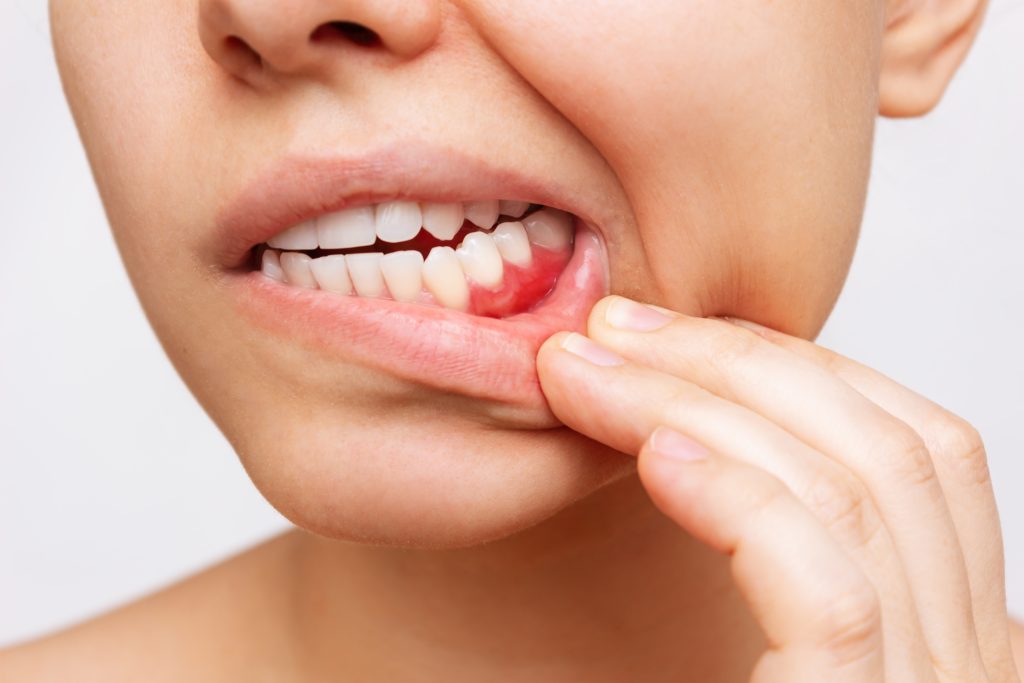
Gums that bleed when you brush or floss are so common that most people assume they are normal, or that they are brushing too hard. Healthy gums do not bleed when cleaned properly. Bleeding is the earliest visible sign of inflammation, and it is also the stage at which the problem is most easily reversed.
What causes it
In the great majority of cases the cause is plaque sitting undisturbed along the gum line. Plaque is a bacterial film that forms within hours of cleaning. Left in place, it triggers an immune response in the gum tissue: the tissue becomes inflamed, its capillaries dilate and become fragile, and the gum bleeds at the slightest contact.
Within a couple of days, plaque begins to harden into calculus, which bonds to the tooth and cannot be brushed off. Calculus is rough, which holds more plaque against the gum, and the cycle accelerates. That is why the problem tends to escalate rather than plateau.
Other contributors
- Cleaning that misses between the teeth. Brushing reaches roughly three of the five surfaces of a tooth. The two surfaces between teeth are where gum disease most often starts.
- Starting to floss after a long gap. Bleeding in the first week is inflamed tissue responding. It should settle, not persist.
- Smoking. Smoking suppresses bleeding by constricting blood vessels, which masks the warning sign while the underlying disease continues.
- Hormonal changes. Pregnancy and puberty increase the gum response to the same amount of plaque.
- Some medications, including blood thinners and certain blood pressure medications. Mention everything you take.
- Rough or overhanging restorations, and poorly fitting appliances, which create plaque traps.
- General health conditions that affect immune response or healing. Persistent gum inflammation that does not respond to good cleaning is worth reporting to your doctor as well as your dentist.
Gingivitis and periodontitis are not the same thing
Gingivitis is inflammation confined to the gum tissue. The gums are red, puffy and bleed easily, but the bone and the attachment holding the tooth are intact. Gingivitis is fully reversible. Remove the plaque and calculus, keep the area clean, and the tissue returns to health within a couple of weeks.
Periodontitis is what follows when inflammation persists. The attachment between gum and tooth breaks down, a pocket forms, and bone supporting the tooth is progressively lost. Bone loss is not reversible. Periodontitis can be halted and managed, but the support already lost does not come back, and untreated it is the most common cause of tooth loss in adults.
The transition is usually silent. There is rarely pain, and often nothing more dramatic than bleeding, bad breath and a feeling that food catches in new places. That is why measured pocket depths at a routine check-up matter: they detect the change before you can feel it.
What actually fixes it
- Have the calculus removed professionally. No home technique removes hardened deposits. This is the non-negotiable first step.
- Clean between the teeth every day. Floss or interdental brushes, whichever you will actually use. Interdental brushes are more effective where the spaces allow them.
- Brush twice daily with a soft brush angled at forty-five degrees into the gum line, with light pressure. Hard brushing causes recession without removing more plaque.
- Keep brushing the area that bleeds. The instinct to avoid it is exactly backwards. Gentle, consistent cleaning is what allows the inflammation to settle.
- Stop smoking if you smoke. It is the single largest modifiable risk factor for periodontal disease.
- Return for review. Where pockets have formed, deeper cleaning under local anaesthetic and a shorter recall interval are usually needed.
Expect improvement within one to two weeks of consistent cleaning after a professional clean. Bleeding that persists beyond that despite good technique needs reassessment.
When to book rather than wait
Book an appointment if bleeding has continued for more than two weeks, if your gums have receded or teeth look longer, if you have persistent bad breath or a bad taste, if any tooth feels loose or your bite feels different, or if there is pus, swelling or pain. Swelling with pain and fever should be seen the same day as an emergency appointment.
What treatment costs
Our new patient consultation and clean package starts from $219 and includes examination, full mouth OPG x-ray, photographs, clean and mineral treatment. Where inflammation extends below the gum line, additional deeper cleaning may be recommended and will be quoted before it proceeds. Current fees are on our price list, and there is more on cleans at our Canberra practice.
Common questions
Should I stop flossing if it makes my gums bleed?
No. Provided your technique is gentle and correct, bleeding when you resume flossing reflects existing inflammation and should settle within one to two weeks of daily cleaning.
Can mouthwash fix bleeding gums?
Antiseptic mouthwash can reduce bacterial load as a short-term adjunct, but it does not remove plaque or calculus from between the teeth. It supports mechanical cleaning rather than replacing it.
Is gum disease hereditary?
Susceptibility varies between individuals, and family history is one factor among several. It changes how closely you should be monitored rather than making the outcome inevitable.
Why do my gums bleed in only one spot?
Localised bleeding often points to something specific in that area, such as food impaction, an overhanging filling margin or a deeper pocket. It is worth having that site examined directly.
Booking an appointment in Canberra City
Civic Gentle Dental Care is at Suite 8, Level 3/161 London Circuit, Canberra City, a short walk from the Canberra Centre. To arrange an appointment, call (02) 6247 0224 or send us a message through our contact page.
This article is general information only and is not a substitute for individual dental advice. Whether a treatment is suitable for you, and what it will involve, can only be determined after an examination by a dentist. Any prices mentioned are estimates drawn from our current price guide and are not a quote.