The short answer is no. Teeth move throughout life in response to sustained gentle force, which is the mechanism orthodontics uses and also the reason teeth drift after treatment if retainers are abandoned. Biology does not switch this off at a particular birthday.
Many adults straighten their teeth with clear aligners. We offer Invisalign, Spark and Angel Aligner.
That said, treating an adult is not identical to treating a fourteen year old, and the differences are worth knowing before you start.
What is different about adults
No growth to work with
In a growing child, jaw discrepancies can sometimes be influenced by guiding growth. In an adult the skeletal relationship is settled, so treatment works within it by moving teeth. Where the underlying discrepancy is substantial, the realistic options are compromise within the existing skeleton or a combined surgical approach, and an honest assessment says which applies.
Movement is often slower
Bone remodels more slowly with age and denser bone resists movement, so adult treatment frequently takes somewhat longer than the same movement in a teenager.
The mouth has a history
Adults arrive with crowns, bridges, implants, fillings, root-treated teeth, worn edges and sometimes missing teeth. Implants do not move, so they act as fixed anchors and the plan has to be built around them. Crowns and veneers need particular attachment techniques. None of this prevents treatment, but it shapes it.
Gum health is the gating factor
This is the important one. Moving teeth through inflamed gums or reduced bone support accelerates the loss. Gum disease must be diagnosed, treated and stable before orthodontic treatment starts, and monitored throughout. Where bone support is reduced, treatment can often still proceed with lighter forces and closer supervision, but the assessment comes first, always.
Different priorities
Adults tend to want discretion and predictability, and care more about how treatment fits around work and life than about the colour of their elastics. That is a legitimate input into the choice of appliance.
Reasons beyond appearance
Plenty of adults come for how their teeth look, and that is reason enough. But there are functional arguments that often matter more:
- Crowded teeth are harder to clean, which raises decay and gum disease risk in exactly the places least accessible.
- Uneven load concentrates force on particular teeth, contributing to wear, cracks and failing restorations.
- Drifted teeth around an old gap may need repositioning before a tooth can be replaced properly.
- A deep bite can wear the lower front teeth or traumatise the gum behind the upper ones.
- Pre-restorative alignment. Straightening teeth before veneers often means less enamel removed and a better result, which is covered in porcelain or composite veneers.
The options
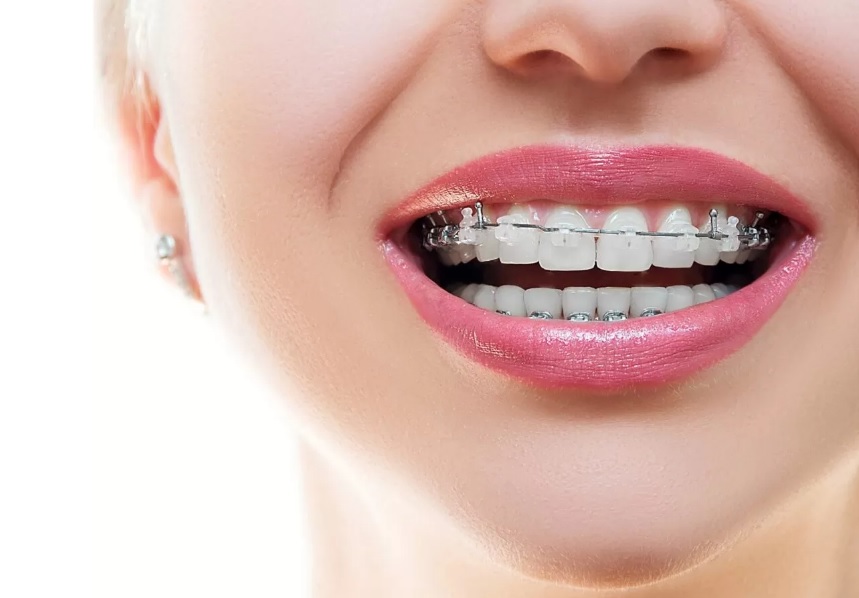
Clear aligners are the common adult choice for their discretion and the fact that they come out to eat and clean, which suits both professional life and the cleaning demands of an adult mouth. Fixed braces retain an advantage in complex movements, and ceramic brackets are less visible than metal. Some cases suit a combination, and limited treatment addressing only the front teeth is sometimes appropriate where the bite is otherwise sound, though it is worth understanding what it does and does not correct. The comparison is set out in Invisalign or braces.
Retention is the part adults underestimate
Teeth drift back toward their original positions, most rapidly in the first months after appliances come off, and the tendency continues for life. Retention therefore has no end date: a bonded wire behind the front teeth, a removable retainer worn at night, or both. Adults who have been through treatment once and skipped retention are a significant proportion of the people asking about treatment a second time.
At our practice, Invisalign treatment includes final retainers. Invisalign Vivera retainers start from $990, removable retainers range from $170 for a single up to $500 for three sets, and a fixed retainer is $350 per arch.
What the assessment covers
Photographs, x-rays, a digital scan, an examination of the teeth and gums including pocket measurements, and an assessment of the bite. From that you should receive a plan with the intended movements, an estimated duration, the appliance recommended and why, itemised costs, and what retention will involve afterwards. For aligner treatment, a digital plan showing the sequence of movements can usually be reviewed before you commit.
What it costs
At Civic Gentle Dental Care, Invisalign ranges from $4,200 to $8,990 and includes iTero scans, smile design and work-up, a virtual smile review, customised aligners, final retainers and take-home whitening gels. Traditional metal braces range from $4,000 to $8,000. Where gum treatment is needed first, that is quoted separately.
Many health fund extras policies include orthodontics, generally with a lifetime limit and waiting periods, so it is worth checking your cover before committing. Current fees are on our price list, with more on Invisalign and braces.
Common questions
Am I too old at fifty? Sixty?
Age itself is not a barrier. Gum health and bone support are what determine suitability, and those are assessed individually.
How long will it take?
It depends entirely on what needs to move. Minor corrections can take months; comprehensive cases commonly run one to two years. You get an estimate specific to your case after the planning stage.
Can I have treatment with crowns and implants already in place?
Usually yes. Implants do not move and are planned around; crowns and veneers need specific attachment techniques. Tell the dentist everything you have had done.
Will my teeth move again afterwards?
Without retention, yes. Retainers are an ongoing commitment rather than a short post-treatment phase.
Booking an appointment in Canberra City
Civic Gentle Dental Care is a dentist in Canberra City at Suite 8, Level 3/161 London Circuit, a short walk from the Canberra Centre. To arrange an appointment, call (02) 6247 0224 or send us a message through our contact page.
This article is general information only and is not a substitute for individual dental advice. Whether a treatment is suitable for you, and what it will involve, can only be determined after an examination by a dentist. Any prices mentioned are estimates drawn from our current price guide and are not a quote.