
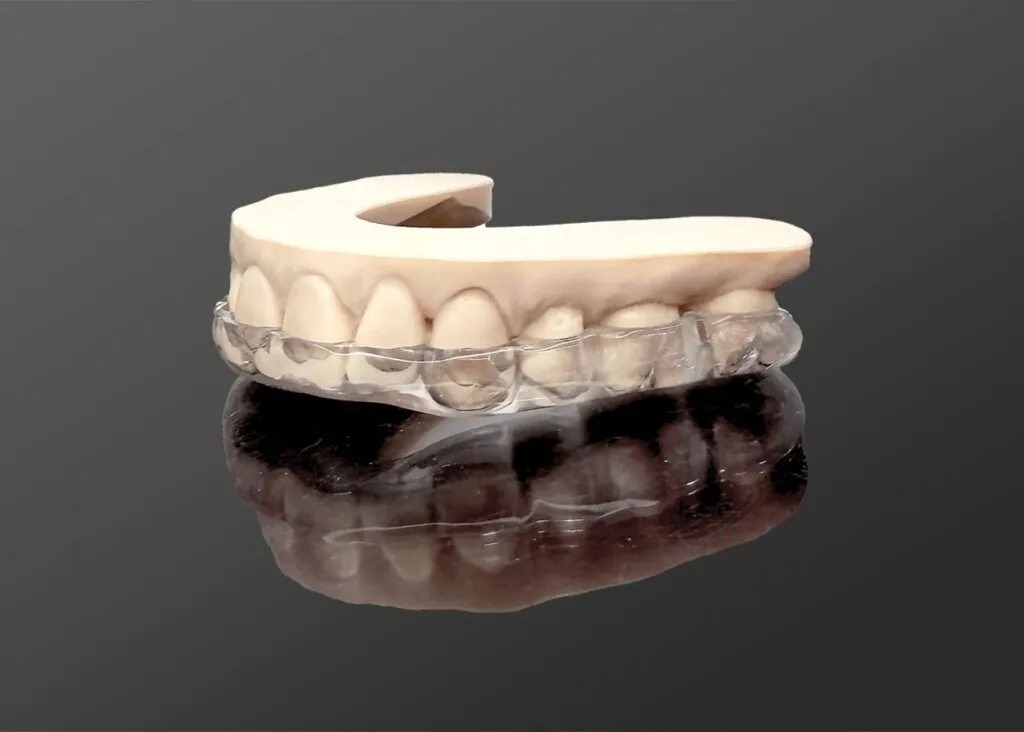
Clear aligners and fixed braces are both capable of producing a well-aligned bite. The differences that matter in practice are less about the end result and more about what the treatment asks of you along the way, and whether your particular case suits removable appliances at all.
How each works
Fixed braces bond brackets to the teeth and connect them with a wire. Adjusting the wire and adding auxiliaries such as elastics applies continuous, controlled force. Because the appliance is attached, it works whether or not you think about it.
Clear aligners are a sequence of removable trays, each slightly different from the last, worn in order. Small tooth-coloured attachments are usually bonded to certain teeth to give the aligners something to grip. Each tray moves the teeth a small increment, and the sequence is planned digitally from the outset.
The practical differences
Visibility
Aligners are close to unnoticeable in normal conversation. Ceramic brackets are less visible than metal but still apparent. For adults in client-facing work, this is often the deciding factor.
Discipline
Aligners need to be worn twenty to twenty-two hours a day, removed only for eating and cleaning. Treatment that is planned around twenty-two hours and delivered at sixteen does not simply take longer, it can go off track, requiring new scans and a revised plan. Braces remove this variable entirely, which is one reason they are often preferred for teenagers and for anyone who knows their own habits.
Eating and cleaning
Aligners come out to eat, so nothing is off the menu, and you brush and floss normally. Braces impose real restrictions: hard, sticky and chewy foods can break brackets, and cleaning around brackets and wires takes noticeably more effort. Decalcification marks around brackets in patients who cleaned poorly are a common and avoidable outcome.
Comfort
Both produce pressure and tenderness for a few days after each change or adjustment. Braces additionally tend to rub the cheeks and lips, particularly early on, which wax manages.
Appointments
Aligner treatment usually involves less chair time, with reviews every six to ten weeks and trays changed at home. Braces need regular in-practice adjustments. Aligner treatment also has fewer unscheduled visits, because there are no brackets to debond.
Case complexity
This is where the honest answer matters. Aligners handle crowding, spacing and many bite corrections very capably. Braces retain an advantage in cases involving large rotations of round teeth, significant vertical movement of individual teeth, closing extraction spaces and complex skeletal discrepancies. Some cases are most effectively treated with a combination.
A case that is genuinely borderline is a case where a second opinion is worth having. Any provider should be able to explain why they are recommending one over the other in your specific mouth.
What happens first
Either way, treatment begins with records: photographs, x-rays and a digital scan, plus an examination to confirm the teeth and gums are healthy enough to move. Active decay and gum disease are treated first, always. For aligner treatment, a digital plan is then built showing the intended sequence of movements, which you can review before committing.
Retainers are not optional
Teeth have a strong tendency to drift back toward their original positions, most rapidly in the first months after the appliance comes off. Retention is a lifelong commitment in some form, whether that is a bonded wire behind the front teeth, a removable retainer worn at night, or both. Skipping retention is the most common reason people end up considering treatment twice. We cover this in caring for dental work terms elsewhere, but the retainer point deserves its own emphasis: budget for it from the start.
Our Invisalign treatment includes final retainers post-treatment. Invisalign Vivera retainers start from $990, removable retainers range from $170 for a single up to $500 for three sets, and a fixed retainer is $350 per arch.
What each costs
At Civic Gentle Dental Care, Invisalign treatment ranges from $4,200 to $8,990 and includes iTero scans, smile design and work-up, a virtual smile review, customised aligners, final retainers and take-home whitening gels. Traditional metal braces range from $4,000 to $8,000. The figure within those ranges depends on how much movement is required and how long treatment runs.
Interest-free payment plans are available through external providers, subject to their assessment and approval. Orthodontic treatment is generally not covered by the Child Dental Benefits Schedule, though many health funds include it under extras with waiting periods and annual limits. Current fees are on our price list, with more detail on Invisalign and braces.
Common questions
How long does treatment take?
It depends entirely on what needs to move. Minor corrections can be a matter of months; comprehensive cases commonly run one to two years for either appliance. An estimate specific to your case comes out of the planning stage.
Can I switch from aligners to braces partway through?
Yes, and it happens occasionally where a case proves more complex than planned or wear time has been inconsistent. It affects cost and timeline, so raise it early if you are struggling.
Will treatment affect my speech?
Both can cause a temporary lisp that most people adapt to within a week or two.
Can I whiten my teeth during treatment?
Whitening is generally done after alignment is complete, so the whole tooth surface is treated evenly and the final result can be assessed against the finished position.
Booking an appointment in Canberra City
Civic Gentle Dental Care is a dentist in Canberra at Suite 8, Level 3/161 London Circuit, Canberra City, a short walk from the Canberra Centre. To arrange an appointment, call (02) 6247 0224 or send us a message through our contact page.
This article is general information only and is not a substitute for individual dental advice. Whether a treatment is suitable for you, and what it will involve, can only be determined after an examination by a dentist. Any prices mentioned are estimates drawn from our current price guide and are not a quote.