Replacing a back molar is largely an engineering problem: restore function, distribute load, make it cleanable. Replacing an upper front tooth is that plus an aesthetic problem that is considerably less forgiving, because the result sits in the middle of your face next to a natural tooth doing the comparison for everyone.
What makes it harder
The gum is visible
Around a molar, nobody sees the gum. Around an upper front tooth, the contour of the gum margin and the small triangle of tissue between the teeth are as visible as the tooth itself. A technically perfect crown with a gum margin one millimetre higher than its neighbour reads as wrong even to people who cannot say why.
The bone is thin, and it disappears
The bone on the outer surface of an upper front tooth is often less than a millimetre thick. When the tooth is removed, that thin plate resorbs quickly, taking the gum contour with it and leaving a visible dip. This is why what is done at the moment of extraction matters so much.
Matching a single tooth is the hardest shade case
Matching several teeth together is easier than matching one tooth to the natural tooth beside it, because a natural tooth has internal colour variation, translucency at the edge and surface texture that all have to be reproduced. A whole set can be made consistent; a single unit has to match something already there.
The decisions, in order
1. At extraction
Where the tooth is still present, the socket is usually grafted at the time of removal to preserve bone volume and the gum contour above it. It is far easier to keep bone than to rebuild it later. In some cases an implant can be placed at the same appointment, which is a judgement made from the scan and the condition of the socket walls.
2. What goes in the gap meanwhile
Nobody is expected to walk around with a visible gap for months. A temporary option is part of the plan from the start: a removable denture with one tooth, a temporary bridge bonded to the neighbouring teeth, or a temporary crown on the implant where circumstances allow.
3. The definitive replacement
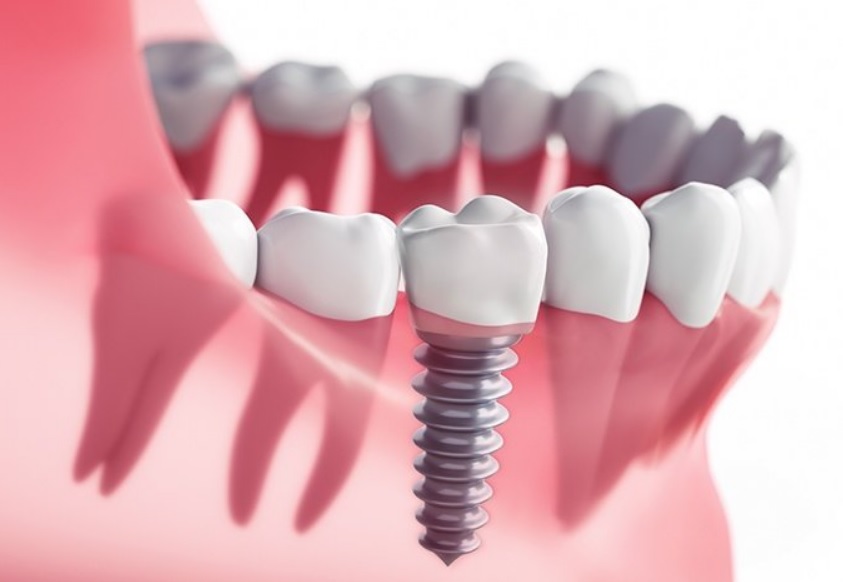
- Implant. Usually the preferred option for a single front tooth because it leaves the neighbouring teeth untouched and maintains bone. It takes longest and demands the most from the bone and gum. See the dental implant timeline.
- Bridge. Faster and fixed, but the teeth either side are reduced to hold it. Sensible when those teeth already carry large restorations; a real cost when they are pristine.
- Resin-bonded bridge. A conservative option for a single front tooth, with a wing bonded to the back of one adjacent tooth and minimal preparation. Less durable than a conventional bridge, but far kinder to the neighbouring tooth, and it is worth asking about.
- Removable partial denture. Lowest cost, quickest, useful as an interim while bone heals.
The full comparison is in implant, bridge or denture for a missing tooth.
Timing, and why it is longer here
A front tooth case is usually staged: extraction and grafting, then two to three months of healing, then implant placement, then three to six months of integration, then the crown. Where bone or gum has already been lost, additional grafting adds months. Rushing produces a result that looks acceptable at fitting and deteriorates as the tissue settles.
The gum contour also continues to mature for months after the crown is fitted, which is why a provisional crown is often used first to shape the tissue before the final one is made.
Getting the appearance right
Handcrafted work earns its place here. At our practice, porcelain crowns and veneers are made by master ceramists in the group’s dedicated in-house ceramic laboratory, layering porcelain to reproduce the internal colour and translucency of the neighbouring tooth. For a single anterior unit this generally gives a better result than a milled monolithic crown, which is the trade-off discussed in same-day crowns.
Two practical points. Whiten first if you intend to whiten, because the crown will not change colour afterwards. And expect the ceramist to want photographs, and sometimes to see you in person, which is a good sign rather than an inconvenience.
What it costs
Dental implants at Civic Gentle Dental Care start from $5,500, including the CBCT scan, planning and placement, the abutment, and the porcelain crown designed by a master ceramist. Grafting, sinus lifts and extractions are quoted separately. Porcelain crowns start from $1,800 per unit, which gives an indication of bridge costs per tooth involved. Dentures range from $800 to $2,800.
Interest-free payment plans are available through external providers, subject to their assessment and approval, and early release of superannuation can be applicable for eligible patients and specific treatment types. Current fees are on our price list, with more on dental implants and dental bridges.
Common questions
Can I have an implant and crown in one day?
Immediate placement with a temporary crown is possible in selected cases with good bone and an intact socket. The final crown still comes later, after integration.
Will anyone be able to tell?
A well-executed single front tooth replacement is generally indistinguishable in normal conversation. Results depend on bone volume, gum contour and the adjacent teeth, which is why the assessment comes first.
What if I have already been missing the tooth for years?
Bone will have resorbed, so grafting is likely to be needed before an implant. The CBCT scan answers what is possible.
Is a bridge a reasonable choice for a front tooth?
It can be, particularly where the neighbouring teeth already carry crowns or large fillings. Where they are untouched, a resin-bonded bridge or an implant preserves them better.
Booking an appointment in Canberra City
Civic Gentle Dental Care is a Canberra City dentist at Suite 8, Level 3/161 London Circuit, a short walk from the Canberra Centre. To arrange an appointment, call (02) 6247 0224 or send us a message through our contact page.
This article is general information only and is not a substitute for individual dental advice. Whether a treatment is suitable for you, and what it will involve, can only be determined after an examination by a dentist. Any prices mentioned are estimates drawn from our current price guide and are not a quote.