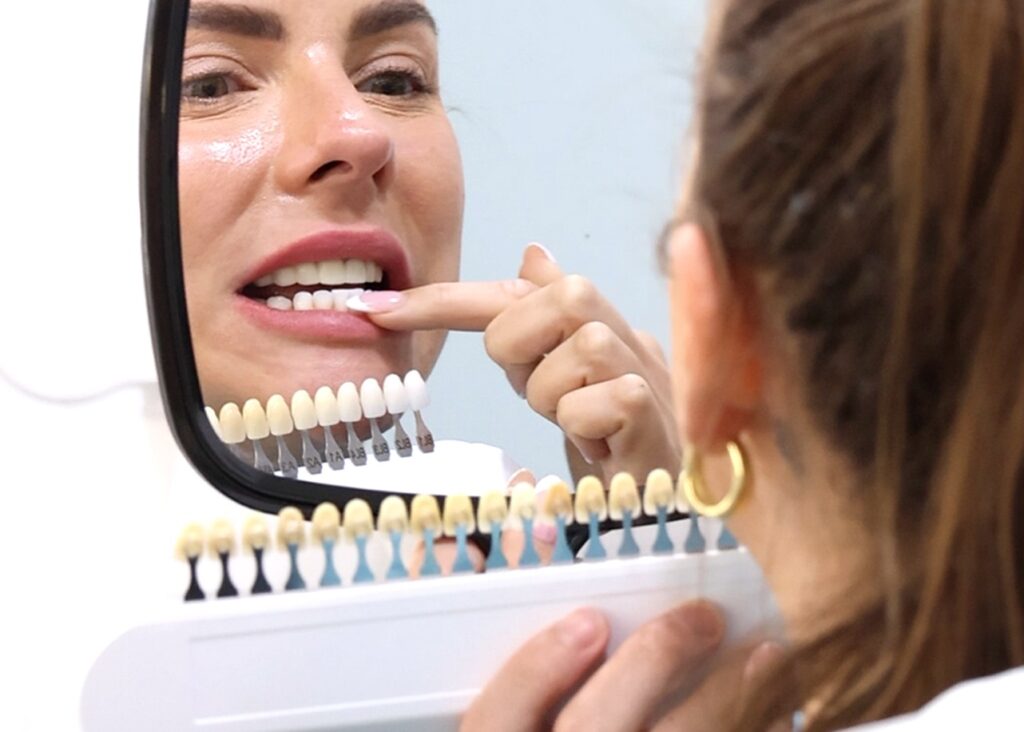
Take-home whitening uses custom-made trays and a peroxide gel you wear at home over about two weeks, giving a gradual result you can control. In-chair whitening is done at the practice in a single appointment, using a stronger gel applied and monitored by the dental team, for a faster result. Both work on the same principle and can reach a similar shade. Many people choose a combination: in-chair to start, then trays to finish and top up.
Which suits you depends on how quickly you want a result, how sensitive your teeth are, and how much you want to be involved. Here is how they compare.
How whitening works
Professional whitening uses a peroxide-based gel. The peroxide passes into the enamel and breaks down the pigmented molecules that make teeth look yellow or darker. It changes the colour of the tooth itself rather than scrubbing stain off the surface, which is why it works where whitening toothpastes do not.
Whitening only works on natural teeth. Crowns, veneers and tooth-coloured fillings do not change colour. See why whitening does not change crowns and veneers.
Take-home whitening
We take a digital scan and make trays that fit your teeth closely. You apply a small amount of gel to the trays and wear them for a set time each day, usually over about two weeks.
- Gradual and controllable. You can stop once you reach the shade you want.
- Gentler on sensitive teeth, because the gel is lower strength and you can take a day off if needed.
- Reusable trays for top-ups later with extra gel.
- Takes commitment. Results depend on wearing the trays as directed.
In-chair whitening
The gums are protected, and a higher-strength gel is applied to the teeth in the practice, usually in several cycles during one appointment.
- A noticeable change in one visit, useful before an event. See whitening before a wedding or event.
- Supervised throughout by the dental team.
- More likely to cause temporary sensitivity, because of the stronger gel.
- Often followed by trays to stabilise and maintain the result.
Side by side
| Take-home | In-chair | |
|---|---|---|
| Time to result | About two weeks | One appointment |
| Gel strength | Lower | Higher, applied by the team |
| Sensitivity | Usually mild | More common, usually temporary |
| Control over shade | High, day by day | Set during the visit |
| Top-ups | Reuse your trays | Trays or another session |
| Price at our practice | $489 | From $699 |
The combined in-chair and take-home package is $998. More detail is on our teeth whitening page.
Before you whiten
Whitening should start with a check-up. Decay, leaking fillings and gum problems should be treated first, because peroxide on an exposed nerve or open cavity can be painful. A clean beforehand also removes surface stain, so you can see the true starting shade. If teeth are discoloured for a specific reason, such as a dead nerve or tetracycline staining, whitening may not be the best option, and our article on why teeth discolour explains the causes.
Sensitivity and how to manage it
Temporary sensitivity is the most common side effect of either method. It usually settles within a day or two of stopping. Using a sensitive toothpaste for a couple of weeks beforehand, wearing trays for shorter periods or every second day, and avoiding very cold drinks during treatment all help. Desensitising products are available if needed.
How long the result lasts
Results typically last many months to a few years, depending on what you eat and drink. Coffee, tea, red wine and smoking bring colour back sooner. Occasional top-ups with your trays keep the shade where you want it.
Who should not whiten, or should wait
Whitening is not recommended during pregnancy or breastfeeding, for children whose teeth are still developing, or while there is untreated decay, gum disease or exposed roots. People with very sensitive teeth may need a gentler regimen or desensitising treatment first. If front teeth have crowns or veneers that will not change colour, it is worth planning whether those will be replaced to match.
Getting the best result
- Have a check-up and clean before you start, so you begin from your true shade
- Wear take-home trays exactly as directed, and keep the gel off the gums
- During treatment and for 48 hours after, limit coffee, tea, red wine, curry and smoking, when teeth absorb stain most readily
- Use a sensitivity toothpaste if teeth feel tender
- Keep your trays for occasional top-ups
Our article on why teeth discolour explains the causes of different stains and which respond best to whitening.
Common questions
Does whitening damage enamel?
Professional whitening used as directed is not known to damage enamel. Overuse and unsupervised high-strength products can cause irritation and sensitivity.
Can I whiten if I have veneers or crowns on front teeth?
The natural teeth will whiten but the restorations will not, so they may no longer match. Plan whitening before any front crowns or veneers are made.
Which gives the whitest result?
Both can achieve similar shades. In-chair is faster; take-home is more gradual. The combination often gives the most stable result.
Is whitening covered by health funds?
Generally not, as it is a cosmetic treatment. Check your policy.
Booking an appointment in Canberra City
Civic Gentle Dental Care is a dentist in Canberra at Suite 8, Level 3/161 London Circuit, Canberra City, a short walk from the Canberra Centre. To arrange an appointment, call (02) 6247 0224 or send us a message through our contact page.
This article is general information only and is not a substitute for individual dental advice. Whether a treatment is suitable for you, and what it will involve, can only be determined after an examination by a dentist. Any prices mentioned are estimates drawn from our current price guide and are not a quote.