
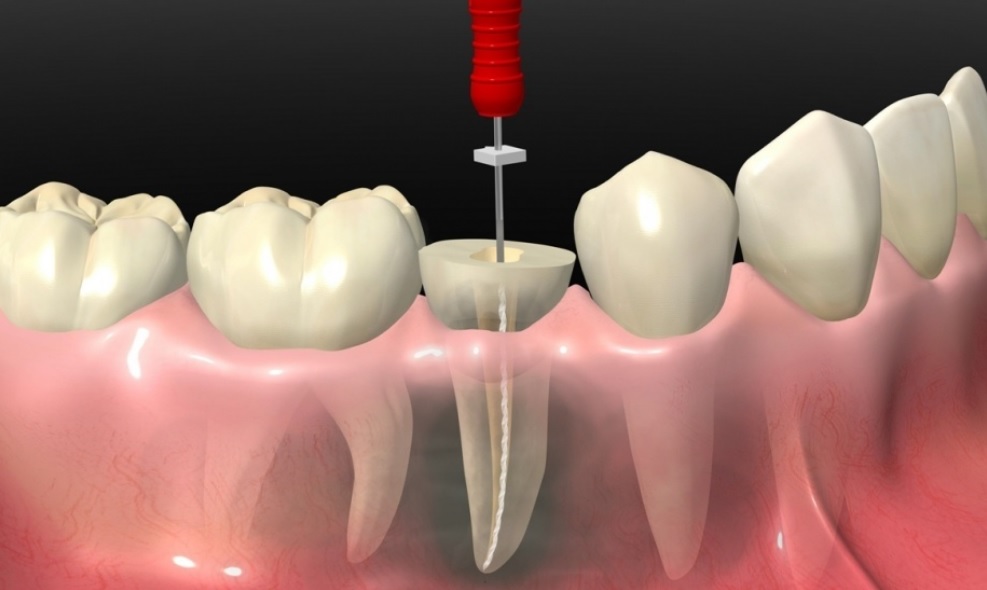
Few dental procedures carry a worse reputation, and few have changed more. The pain people associate with root canal treatment is overwhelmingly the pain that brought them in, not the treatment itself. The procedure is what relieves it.
Here is what actually happens.
Why a tooth needs it
Inside every tooth is a chamber containing the pulp: nerve tissue, blood vessels and connective tissue, running down through canals in each root. When bacteria reach the pulp, through deep decay, a crack, repeated dental work or trauma, it becomes inflamed and then infected.
The pulp cannot recover once the inflammation passes a certain point, and it is sealed inside a rigid chamber, so swelling has nowhere to go. That is the source of the pressure and the throbbing. Untreated, the infection tracks out through the tip of the root into the surrounding bone, forming an abscess.
At that stage there are two options: remove the pulp and seal the tooth, or remove the tooth.
The signs
- Prolonged pain to hot or cold, lingering well after the stimulus is removed.
- Spontaneous pain, particularly pain that wakes you at night.
- Pain on biting or on pressure over the tooth.
- A tooth that has darkened relative to its neighbours.
- A tender or swollen gum near the tooth, or a small pimple-like spot that discharges.
- Facial swelling, which needs same-day attention as an emergency appointment.
A tooth can also need root canal treatment with no symptoms at all, where the pulp has died quietly and the problem is found on an x-ray.
What happens during treatment
- Anaesthetic. The tooth and surrounding tissue are numbed. You should not feel pain during the procedure. Where a tooth is acutely inflamed, achieving profound anaesthesia can take additional technique, so tell the dentist if you feel anything.
- Isolation. A rubber dam is placed over the tooth. This keeps the working area dry and free of saliva and bacteria, which materially affects the outcome. It also stops anything reaching your throat.
- Access. A small opening is made through the biting surface to reach the pulp chamber.
- Cleaning and shaping. The canals are cleaned with fine instruments and irrigated with disinfecting solutions. This is the bulk of the appointment, and it is why treatment takes time: molars can have three or four canals, sometimes more, and each has to be cleaned along its full length.
- Measurement. The working length of each canal is measured electronically and confirmed with x-rays, so the cleaning reaches the end of the root without extending beyond it.
- Filling. Once clean and dry, the canals are filled with a rubber-like material and sealer to prevent bacteria re-entering.
- Sealing the access. A filling closes the opening, either as a temporary or a definitive filling depending on the plan.
Where there is significant infection, the dentist may place an antibacterial dressing and complete the filling at a second visit. One or two appointments is typical, each commonly sixty to ninety minutes.
The restoration afterwards is not optional
A root treated back tooth has lost a good deal of internal structure and is more prone to fracture. A crown or onlay is usually recommended to protect it, and the timing matters: a tooth that fractures while waiting for its crown may not be restorable at all. Front teeth with most of their structure intact can sometimes be restored with a filling alone. We set out the reasoning in filling or crown.
Afterwards
Tenderness to biting for a few days is normal as the tissue around the root settles, and over-the-counter pain relief generally manages it. Avoid chewing hard food on the tooth until the final restoration is placed. Contact the practice if pain is severe or increasing, if swelling develops, or if the temporary filling comes out.
Root canal or extraction?
Keeping a natural tooth is usually preferable where it is restorable. It maintains the bone, keeps the neighbouring teeth from drifting, and avoids the cost and complexity of replacement. Extraction is cheaper upfront, but replacing the tooth afterwards with an implant or bridge generally costs more than the root canal and crown would have. Extraction is the right call when the tooth is fractured below the gum line, when there is inadequate structure to restore, or when the supporting bone is too compromised. Replacement options are compared in implant, bridge or denture.
What it costs
Root canal treatment at Civic Gentle Dental Care ranges from $1,200 to $2,000, varying with the number of roots: anterior teeth $1,200 to $1,300, premolars $1,500 to $1,600 and molars $1,800 to $2,000. That excludes the final restoration of the tooth, whether a crown or a filling. Porcelain crowns start from $1,800 and tooth-coloured fillings range from $209 to $450.
Most health funds pay a rebate toward endodontic treatment under extras cover, and HICAPS is available at the appointment. Current fees are on our price list, with more on our root canal therapy page.
Common questions
Does root canal treatment hurt?
The tooth is anaesthetised throughout, and most patients report the procedure as comparable to having a filling. The severe pain associated with root canals is usually the infection beforehand.
How long does a root treated tooth last?
Well-treated and properly restored teeth can function for many years. Outcome depends on the quality of the seal, the restoration placed afterwards and ongoing oral health rather than a fixed lifespan.
Can the infection come back?
It can, though it is uncommon where the canals have been thoroughly cleaned and sealed and the tooth well restored. Retreatment is possible if it occurs.
Will the tooth go dark?
A root treated tooth can discolour over time, more noticeably on front teeth. Internal bleaching or a crown or veneer can address it if appearance becomes a concern.
Booking an appointment in Canberra City
Civic Gentle Dental Care is a Canberra City dentist at Suite 8, Level 3/161 London Circuit, a short walk from the Canberra Centre. To arrange an appointment, call (02) 6247 0224 or send us a message through our contact page.
This article is general information only and is not a substitute for individual dental advice. Whether a treatment is suitable for you, and what it will involve, can only be determined after an examination by a dentist. Any prices mentioned are estimates drawn from our current price guide and are not a quote.